1 EDUCATION
University of Electronic Science and Technology of China (UESTC) (Sept 2022 — June 2026)
University of Glasgow, Dual Degree Program (Sept 2022 — June 2026)
- Major: Electrical & Computer Engineering BEng; GPA: 3.87/4.0, Ranking: 2/164 (Top 1.2%)
- Relevant Coursework: Information Theory, Stochastic Processes, Flow Matching and Diffusion Models, Reinforcement Learning in LLM, etc.
2 RESEARCH & PROJECTS
LLMlab: Rapid RLVR Post-Training Verification Platform Based on Formal Languages (June 2026)
- Motivation: To reduce the prohibitively high cost of validating LLM training algorithms, LLMlab enables efficient algorithm performance verification on controlled synthetic data.
- Designed a deterministic formal language supporting efficient RLVR algorithm benchmarking across varying levels of language difficulty.
- Implemented a complete pretrain, SFT, GRPO, KD, OPD, and SDPO pipeline with parallel ablation experiments on 2.67M and 0.15M teacher and student models, achieving 100% accuracy on difficulty levels 0–3 and over 70% accuracy on difficulty levels 4–6.
- Integrated a visualization toolkit including PCA-projected loss landscapes with weight trajectory tracking, per-layer attention heatmaps, and exposure bias measurements for in-depth model interpretability and training dynamics analysis.
LLM Post-Training: Reproducing Self-Distillation Policy Optimization (SDPO) Paper (May 2026)
- Successfully reproduced the SDPO algorithm using the verl RL framework on RunPod H100 GPUs, building on a thorough understanding of the algorithm.
- Trained Qwen2.5-3B on code generation tasks using LeetCode-style feedback (runtime errors, failed test cases) as the learning signal, and tracked 40 steps of SDPO training dynamics via WandB, logging mean reward and token-level KL divergence relative to the reference policy.
System-level Co-Design of RISCV Accelerators for TinyML at the Edge (Sept 2025 — April 2026)
Research Assistant, Prof. Yun Li, UESTC
- Engineered a standalone Neural Processing Unit (NPU) for real-time YOLOv8n edge inference on an Artix-7 FPGA, bypassing soft-core processors via a custom RISC-V instruction extension (Xnpu).
- Architected an end-to-end Python ML compiler for automated INT16 quantization and memory-aware instruction scheduling, preserving accuracy within 0.3% mAP of the PyTorch FP32 baseline.
- Designed parameterized RTL operators featuring a 3×3 systolic MAC grid and fully hardware-accelerated post-processing (DFL, NMS), achieving 288 MACs/cycle and 23.4 GOPS peak throughput.
- Integrated asynchronous camera/UDP video pipelines and AXI4 DDR3L memory multiplexing, fully verified via
Cocotb,Bazel, andIcarus Verilog.
YOPO: You Only Pick Once — Light Object Tracking Algorithm (Sept 2025)
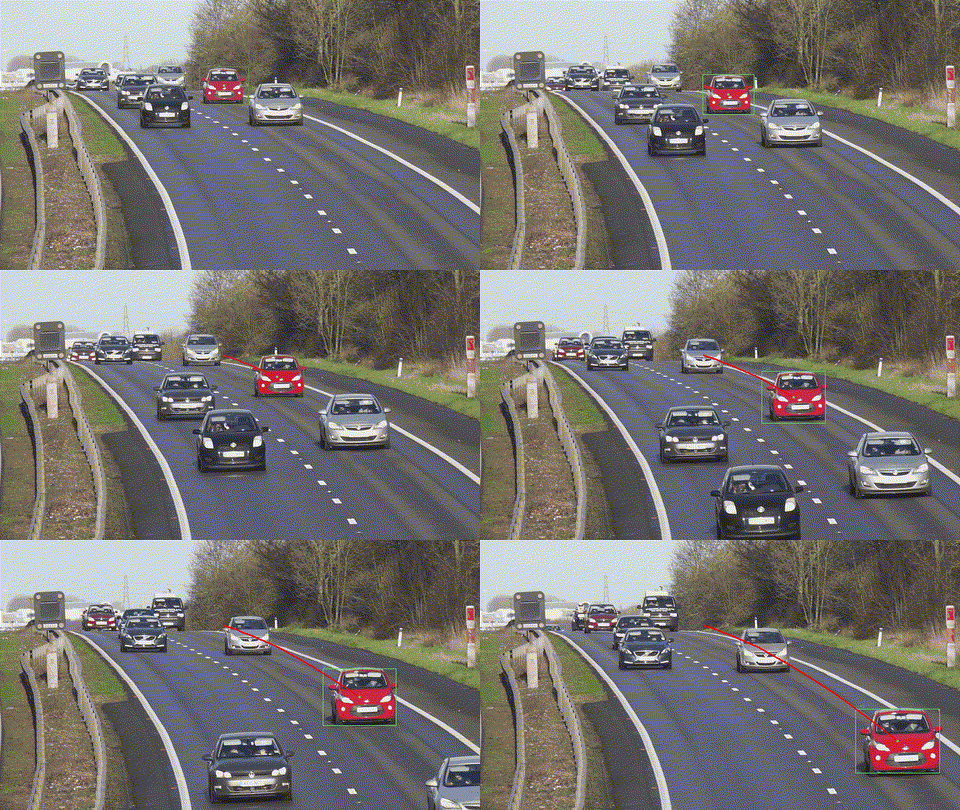
- Developed a lightweight object tracking algorithm that requires only one initial selection, successfully mitigate the intense computation of DNN forward propagation on every frame.
- Utilized NCC-based matching, adaptive kernel updating, capable of tracking objects with gradual color and size changes.
Design and Visualization of a Complete Single-cycle RV32I CPU Core (Jan 2025 — Mar 2025)
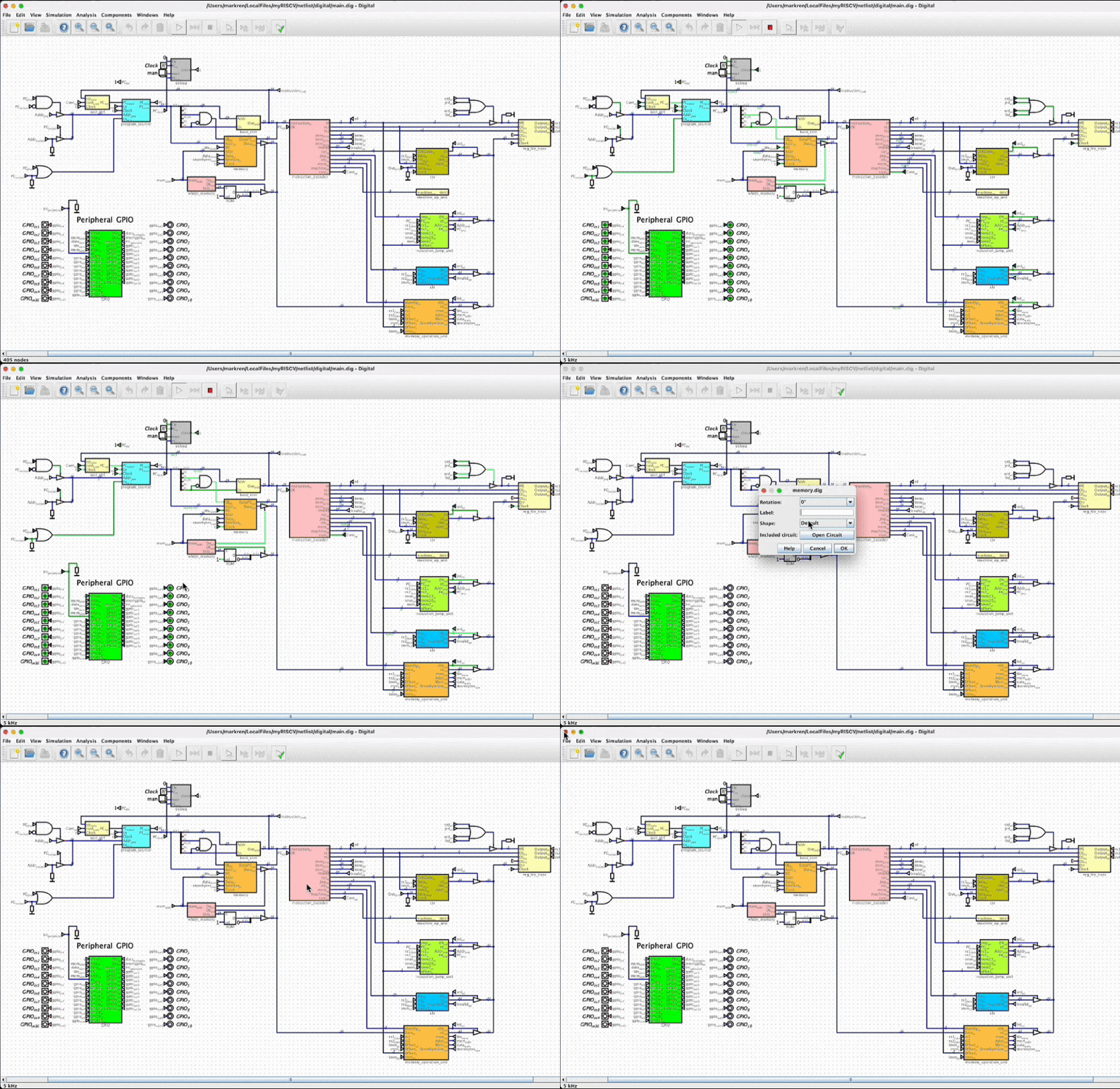
Digital- Designed a single-core, single-cycle RISCV 32-bit CPU from scratch in
Verilogfor RTL simulation and inDigitalSoftware for working principle visualization, open-sourced on Github. - Built a complete datapath including PC, fetcher, decoder, register file, ALU, LRU-based L1 cache, etc., compatible with basic peripherals: GPIOs, IIC, UART, etc.
- Implemented a boot program in RISCV assembly, basic delay and GPIO libraries in
C. Compiled and simulated using RISCV GNU toolchain.
CNN/LSTM for Embedded Systems (Feb 2024 — May 2024)
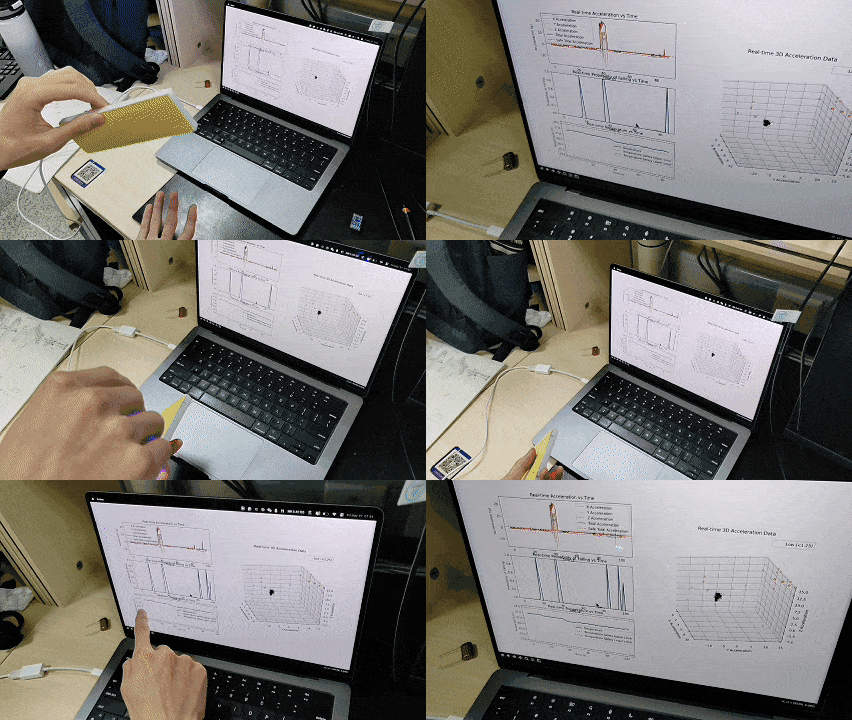
- Designed and Integrated CNN and LSTM models into STM32 MCU for end-to-end patient fall detection of accuracy 95%, temperature monitoring and real-time data visualization.
- Manually collected and labeled time-series 3D acceleration dataset. Trained models on Linux, then hardcoded and accelerated them in
C++on MbedOS for real-time inference.
Human Voice Recognition Smart Car (Sept 2023 — Dec 2023)
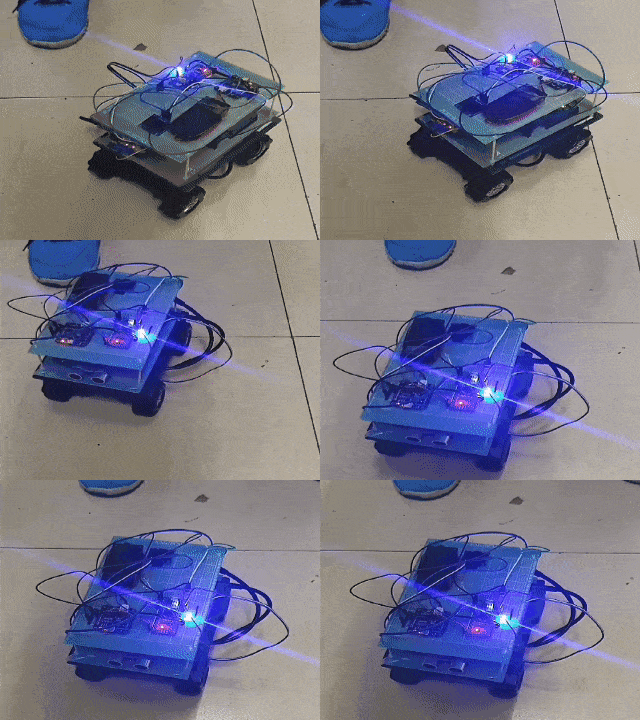
- Designed and implemented a voice-controlled car on STM32F103 using
Cstandard libraries, supporting actions such as moving forwards/backwards, turning/sliding left/right. - Led a 4-member team in the project.
Digital Door Lock for Dormitory (Sept 2023 — Oct 2023)
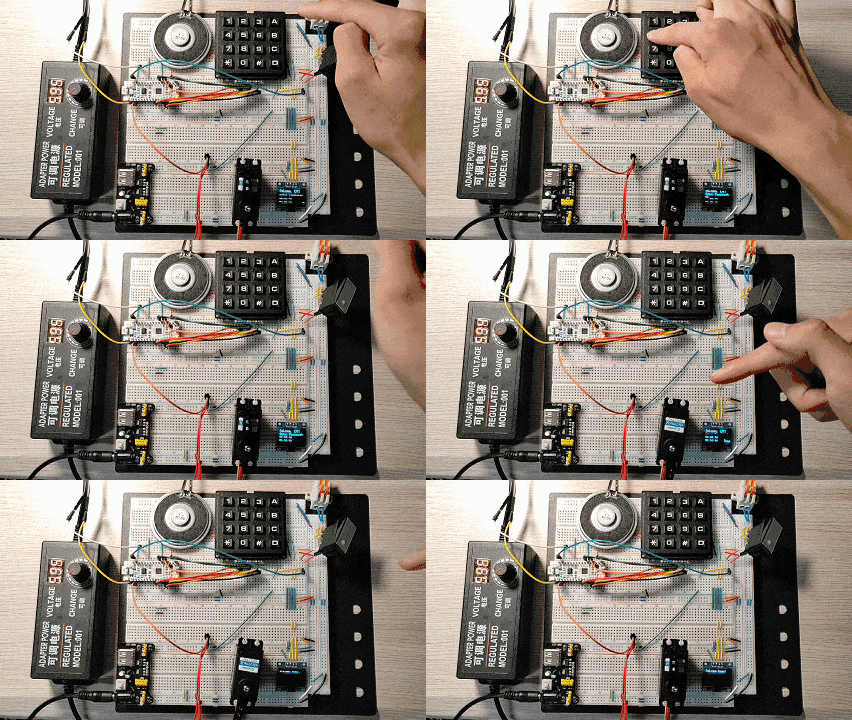
- Designed and implemented an embedded digital door lock system in
C++on Nucleo L432KC MCU. - Developed basic functions include manually setting up password, automatically lock for repeated wrong passwords, OLED message displaying, etc.
- Led a 3-member team in the project.
3 RELEVANT SKILLS
IT Skills: Latex, Quarto Markdown, Linux, Manim, Github.
Programming: Python, PyTorch, C/C++ , Makefile.
Language: Native Chinese, Fluent English (IELTS 7).
4 AWARDS
Top Academic Scholarship of UESTC (Top 5%) (Dec 2023, Dec 2024)
China National Scholarship (Top 0.2%) (Dec 2024)
First Prize: 7th National College Art Exhibition and Performance (Violin section) (Sept 2024)